Welcome to the Victorian Alps: Australia’s High Country
The Victorian Alps, also known as the High Country, represent the southern-most part of the Australian Alps. This region extends from Walhalla in the west to the Cobberas Range in the east.
The area includes major peaks and plateaus such as Mount Bogong, Mount Hotham, and the Baw Baw Plateau. A large portion of this mountainous terrain is protected within the 660,550-hectare Victorian Alpine National Park.
Terrain and Geology
The overall look of the Victorian mountains has been aptly compared to “sleeping dinosaurs,” as parts of the exposed landscape resemble a skeleton with visible “ribs and vertebrae.” This striking topography is a direct result of the region’s unique geological structure.
In Victoria, the Great Dividing Range runs mainly east–west and is narrower and more distinct than it is further north. The terrain features several high-elevation areas separated by lower foothill forests, with Mount Bogong (1,986 m) being the highest peak. Geologically, the mountains consist mostly of sedimentary rocks (making up about 30% of the Victorian Alps) and granite, which forms peaks such as Mounts Buffalo and Baw Baw. The Cobberas plateau, formed from a thick layer of ancient volcanic rock, is another significant feature.
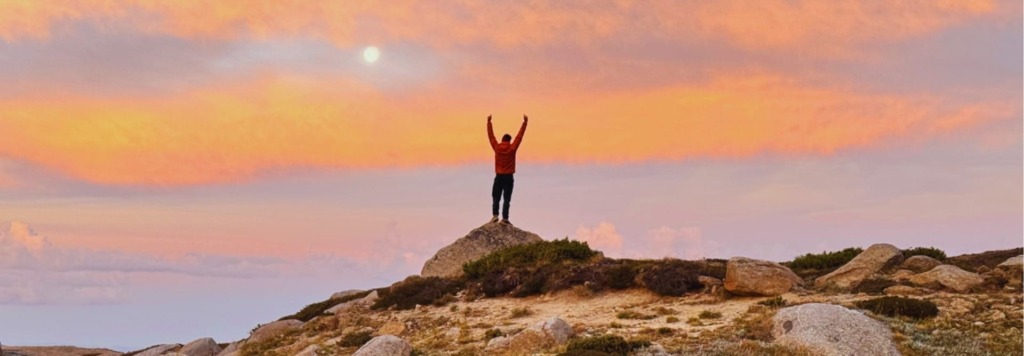
This geological makeup results in several prominent landforms, including the dramatic, tilted sedimentary cliffs of the Crosscut Saw, The Viking, and The Razor. Periglacial features are also evident, particularly block streams (stone rivers) on Mounts Hotham, Loch, and Higginbotham.
Wildlife and Vegetation
Located in a cooler southern climate, the Victorian Alps have a treeline at about 1,600–1,650m, which is roughly 300m lower than in New South Wales. Despite this, the area supports an incredibly diverse flora, including over 1,700 species of flowering plants. This botanical richness, in turn, sustains a unique community of fauna specialised for cold climates.
Flora
Victoria’s true alpine zone, found above the treeline, is limited to small, treeless patches on the Mount Bogong plateau, Mount Hotham, Mount Feathertop, and Mount Nelse. This high-altitude area is a mosaic of plant communities, such as heathlands, grasslands, herbfields, and bogs, with their distribution determined by differences in snow cover and drainage. Below the treeline, the slopes are covered by tall open forests dominated by alpine ash (Eucalyptus delegatensis).
This distinct environment supports several endemic plant species, like the silky snow daisy (Celmisia sericophylla) and the alpine daisy bush (Olearia frostii). Dwarf alpine shrubs, including the mountain plum-pine (Podocarpus lawrencei), are also notable for their longevity, with some individual plants living for as long as 250 years.
Fauna
This region provides critical habitat for several endemic, cold-climate specialists. Among them are the Baw Baw frog, a highland species found only on the Baw Baw plateau, and the endangered broad-toothed rat, which lives in dense, rocky, streamside habitats. Victoria also has significant mountain pygmy-possum populations at Mounts Higginbotham and Loch, the Bogong High Plains, and Mount Buller. Notably, about 80% of the state’s population is found within the Mount Hotham Ski Resort area.
These possums rely on Bogong moths, which migrate to the high country’s rock crevices and boulder fields to aestivate (lie dormant) and serve as a vital food source. While common native animals like wombats and echidnas are also found here (especially in warmer months), these fragile environments are under significant threat. Feral horses are a particular danger, with populations impacting delicate bogs and waterways in the Cobberas area and on the Bogong High Plains.
Historical Significance and Indigenous Connections
Indigenous Heritage
The Victorian Alps are the traditional lands of several Indigenous groups, including the Jaitmathang, Gunai-Kurnai, and Taungaurung. First Nations Peoples made seasonal visits to the high mountains, mainly during summer. A primary traditional activity was harvesting and eating Bogong moths, which could be easily scraped from cool, dark rock crevices on the summits. The Cobberas area, specifically, was part of an ancient Aboriginal pathway that allowed groups to convene for these feasts, which were governed by protocols for ceremony, trade, and celebration. Evidence of this ancient life, such as artefact scatters and scarred trees, has been documented, with many remnants surveyed following the 2003 bushfires. This deep connection endures in language, with the gold-mining town of Walhalla taking its name from the Aboriginal word ‘Wallwah’ (a camp).
Pastoral History
The region’s recent history has also been profoundly shaped by pastoralism. For over 135 years, seasonal grazing provided vital drought relief for livestock, a practice that persisted in parts of the high country until the early 2000s. This long era is commemorated by traditional cattlemen’s huts, like the historic Wallaces Hut, built in 1889. After scientific reports revealed damage to high-altitude catchments, grazing was eventually banned in Victoria’s highest areas, including the Loch–Hotham region, by the late 1950s.
Weather and Seasonality
Typical of high-altitude environments in the Australian Alps, the region’s conditions are highly variable. In summer and autumn, alpine temperatures are relatively mild, but nighttime temperatures can still drop below freezing. Cold air drainage often leads to frost collecting in basins and valleys, which creates localised frost hollows on the plains. The area also endures a long winter, with snow cover that can sometimes last for up to four months.
Best Time for Walking
Generally, the ideal time for walking extends from mid-spring to late autumn. The best and driest weather is usually found from summer through early autumn. Spring is also popular with hikers, as water sources are more plentiful, but the weather is typically more unpredictable during this time. For those interested in flowers, the wildflower season peaks in late January.
Browse all Victorian Alps Tours
- Hiking
- 16 days
- From $7,795
- Hiking
- 16 days
- From $7,995